
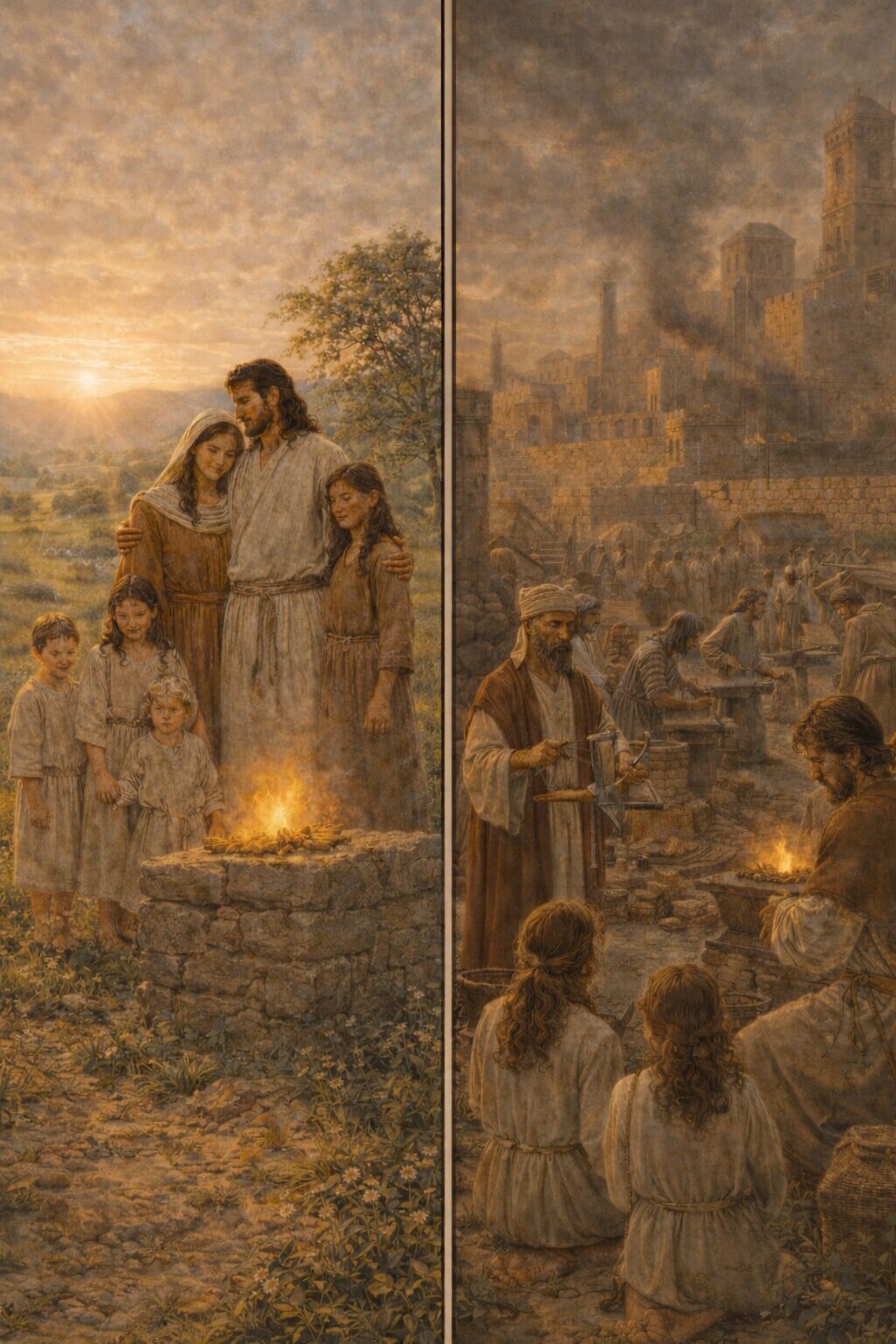
After Adam and Eve left the Garden they began to build a life for their family. They raised crops and animals. They taught their children to worship God and to provide for one another.
It was a simple life, working the land together, sharing, living and learning through that work how to know God. Adam taught them to care for what God had placed in their stewardship, and to treat one another the way God had taught him.
Everything revolved around family, and everything pointed back to God.
God taught Adam the two greatest principles: love God and love your fellowman.
Adam's way kept life ordered around God, family, stewardship, and the care of others.
Cain's way gathered power, wealth, and control into the city.
These two ways continue through the rest of the story.
Part of the Cain and Abel story that is rarely discussed is what Cain did after he departed. The first thing he did was build a city and call it after the name of his son Enoch.
He divided the land and treated it as his own. Once land is claimed this way it can be traded, bought, and sold, and men begin wanting more than their neighbor has. Cain's way moved in that direction.
From Cain's children came men who worked with metals and others who became skilled in music. Wonderful gifts, however in the city these gifts were used for gain, to sell and to have more.
The city was exciting. It promised gratification and accomplishment. Some of Adam's children left their family way of life and went looking for something better in these growing cities.
The world that grew through Cain's way became so full of violence and corruption that God chose to begin again through Noah.
Noah continued Adam's way. He worshiped as Adam taught and raised his family the same way.
Through Ham's rebellion came his sons Mizraim, who began Egypt, and Cush, whose son Nimrod built up Mesopotamia. Both repeated Cain's way and expanded on it.
These civilizations set up kings to rule over the people and priests to worship on their behalf.
Think about what that means.
Adam was a king who loved his family and provided for them. These kings demanded obedience and extracted taxes from the people.
Adam was a priest who lovingly taught his children how to worship and administered to them. These priests separated the people from God and worshiped on the people's behalf, demanding obedience to the increasing rules and regulations they set up.
This is the great contrast. Adam's order kept worship in the family, with God in their midst. Cain's way gathered power into cities, then placed kings and priests over the people.
By setting up kings and priests in this way, these leaders gained control over the people and extracted money and labor from them, offering protection and promises they could not truly fulfill.
This is not a condemnation of sincere people who worship God in religions. Many have been led there by God, and He has met them there. The issue is the pattern itself. Adam taught families to come to God directly. Cain's way placed power between God and the family.
Adam showed a different way: a life rooted in stewardship of the land, family worship, and direct relationship with God, where no man stood between the family and its Creator.
Abraham was born some 400 years after the flood in the city of Ur, deep in the ways of Nimrod. He heard the call of God and walked out of the cities to live as a sojourner and follow the ways Adam taught. The same two ways, the same choice, century after century.
So even while Cain's way spread through the earth, God preserved Adam's way through righteous fathers who heard Him and obeyed Him. The patriarchs are the next part of the story.