Scripture Trading Cards
Heroes and Villains of Scripture
Patriarchs
The Fathers of Faith — Genesis
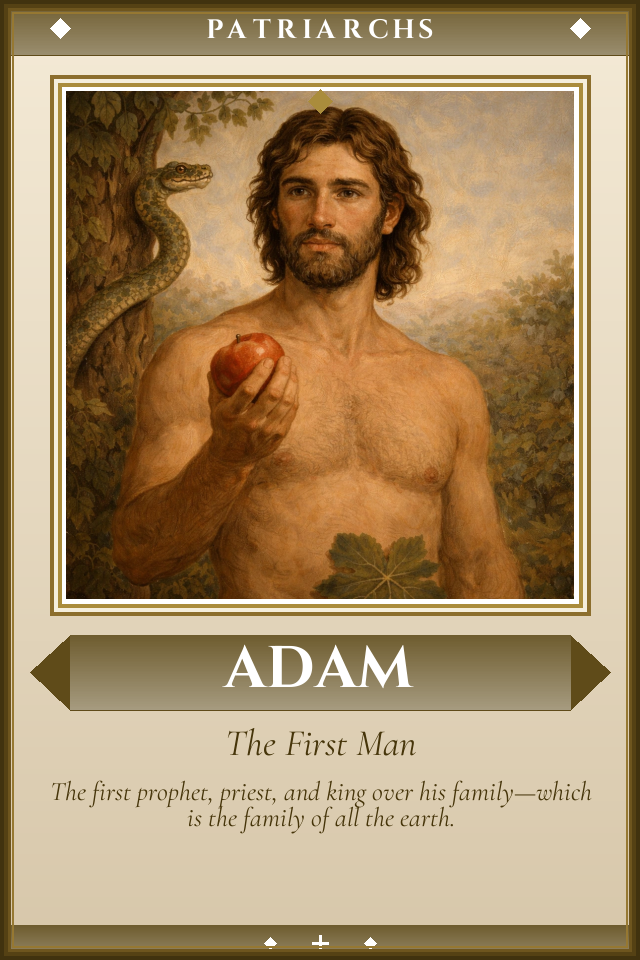
The First Man
Father of the human family; receiver of the first covenant with God.
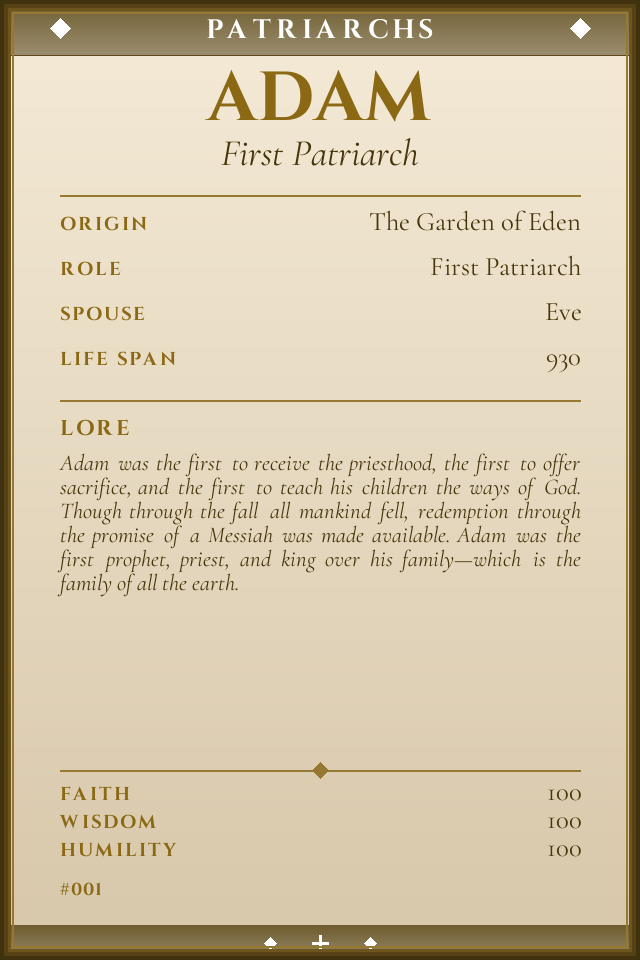
Adam
First Patriarch
Adam, formed from the dust of the ground and given the breath of life, was placed in Eden to tend God's garden. Created in the divine image, he named all living creatures and received God's first command: eat freely, but not from the tree of knowledge. When Eve offered him the forbidden fruit, Adam ate without protest, bringing sin and death upon all humanity. Cursed to toil the ground until returning to dust, he was exiled from paradise. Yet God clothed the shamed couple in animal skins—the first sacrifice. Adam lived 930 years, fathering Seth and becoming the ancestor of all mankind.

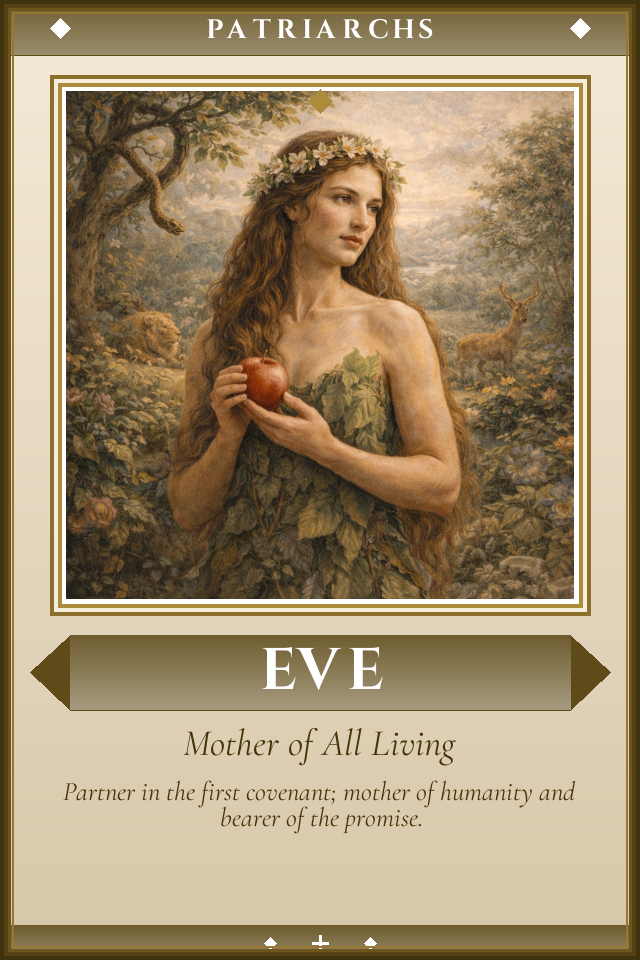
Mother of All Living
Partner in the first covenant; mother of humanity and bearer of the promise.
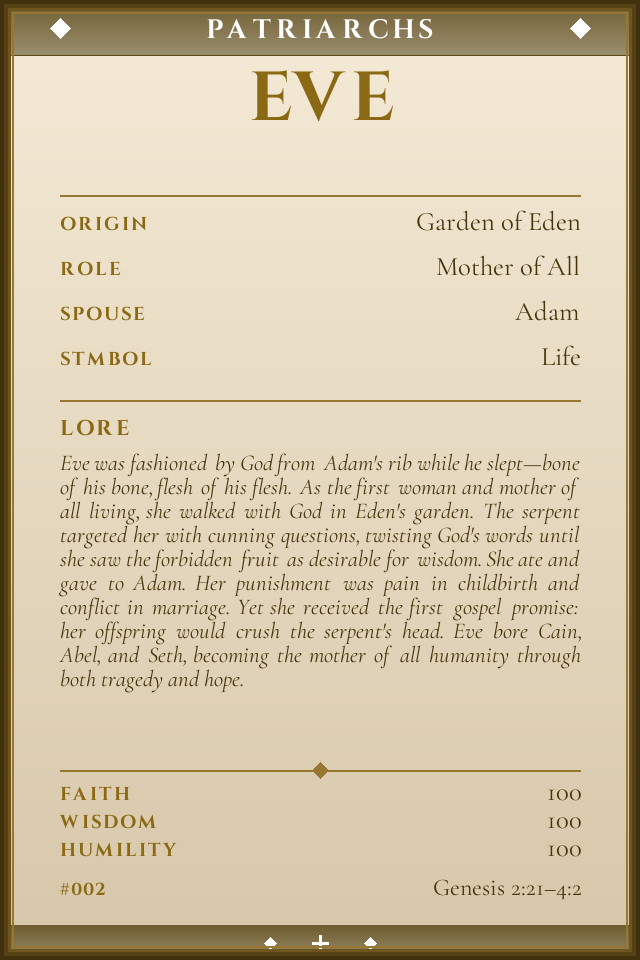
Eve
First Woman
Eve was fashioned by God from Adam's rib while he slept—bone of his bone, flesh of his flesh. As the first woman and mother of all living, she walked with God in Eden's garden. The serpent targeted her with cunning questions, twisting God's words until she saw the forbidden fruit as desirable for wisdom. She ate and gave to Adam. Her punishment was pain in childbirth and conflict in marriage. Yet she received the first gospel promise: her offspring would crush the serpent's head. Eve bore Cain, Abel, and Seth, becoming the mother of all humanity through both tragedy and hope.

The First Martyr
Keeper of sheep whose offering was accepted; slain by his brother.
Abel
The Righteous
Abel, the second son of Adam and Eve, was a keeper of sheep. When the brothers brought offerings to the Lord, Abel presented the firstborn of his flock and their fat portions—the best he had. God looked with favor on Abel's offering but rejected Cain's. What made the difference? Scripture suggests Abel offered by faith, bringing a blood sacrifice that foreshadowed Christ. His brother's jealousy turned to murder, making Abel the first martyr. Jesus called him 'righteous Abel,' and Hebrews declares that though dead, he still speaks—his blood crying from the ground for justice.

First Murderer
Tiller of ground whose offering was rejected; slew his brother Abel.
Cain
Son of Adam
Cain, the firstborn of Adam and Eve, worked the ground. When God rejected his offering while accepting Abel's, Cain's face fell with anger. God warned him: 'Sin is crouching at the door. Its desire is for you, but you must rule over it.' Cain ignored this counsel, lured his brother to the field, and murdered him. When God asked where Abel was, Cain replied, 'Am I my brother's keeper?' Cursed to wander as a fugitive, marked by God for protection, he built the first city. His line produced civilization—but also violence—ending in the judgment of the flood.

Appointed One
Raised in place of Abel to continue the righteous line of Adam.
Seth
Third Son of Adam
Seth was born to Adam and Eve after Abel's murder, given by God as a replacement—his name means 'appointed.' Through Seth's line, humanity continued the worship of the Lord, for in his son Enosh's time 'people began to call upon the name of the Lord.' While Cain's descendants built cities and crafted weapons, Seth's line preserved faith. He lived 912 years, becoming the ancestor of Noah and ultimately of Christ. Seth represents God's faithfulness to continue His purposes despite human sin, providing a godly lineage when the firstborn had failed.

He Who Walked With God
Prophet who established Zion and was translated without tasting death.
Enoch
Son of Jared
Enoch walked with God for three hundred years, a phrase used of no other patriarch. In an age of mounting wickedness before the flood, he maintained intimate fellowship with the Creator. He prophesied judgment on the ungodly, declaring that the Lord would come with thousands of His holy ones. His faith was so profound that God took him directly to heaven—he 'was not, for God took him.' Along with Elijah, Enoch is one of only two people who never died. He lived 365 years on earth, a testimony that walking with God transforms one's destiny entirely.

Son of Cain
First city named after him; born of the line of Cain, the wanderer.
Enoch
City Builder
Enoch walked with God for three hundred years, a phrase used of no other patriarch. In an age of mounting wickedness before the flood, he maintained intimate fellowship with the Creator. He prophesied judgment on the ungodly, declaring that the Lord would come with thousands of His holy ones. His faith was so profound that God took him directly to heaven—he 'was not, for God took him.' Along with Elijah, Enoch is one of only two people who never died. He lived 365 years on earth, a testimony that walking with God transforms one's destiny entirely.
Descendant of Cain
First polygamist; boasted of killing a man who wounded him.
Lamech
The Avenger
Lamech of Cain's line represents the escalation of violence after the fall. He took two wives, violating God's design for marriage, and boasted to them of killing a young man for wounding him. His song of the sword perverted God's protection of Cain: 'If Cain's revenge is sevenfold, then Lamech's is seventy-sevenfold.' His sons pioneered nomadic herding, musical instruments, and bronze and iron tools—cultural advances born from a corrupt line. Lamech embodies how sin compounds across generations, turning God's mercy into an excuse for greater violence.
Longest Living Man
Bridge between Enoch's Zion and the generation of Noah.
Methuselah
Son of Enoch
Methuselah lived 969 years, longer than any other person in Scripture. His name may mean 'when he dies, it shall come'—a prophetic warning that the flood would arrive at his death. His father Enoch walked with God and was taken to heaven; his grandson Noah would save humanity from destruction. Methuselah's extraordinary lifespan represents God's patience, delaying judgment to allow repentance. He died the year of the flood, a final witness to a generation that refused to turn from wickedness. His long life speaks of divine mercy extended to the very end.
Father of Enoch
Sixth from Adam; lived to see the translation of his son Enoch.
Jared
Sixth Patriarch
Jared lived 962 years, the second-longest life recorded in Scripture. His name means 'descent,' marking a time when humanity was declining spiritually before the flood. He was the father of Enoch, who would walk with God and be taken to heaven without dying. Jared witnessed both the spreading corruption of the pre-flood world and his son's remarkable faithfulness. He lived to see Enoch's translation and continued for centuries after. In the genealogy from Adam to Noah, Jared represents the generations that persevered in faith while the world around them grew ever more wicked.
Father of Noah
Named Noah prophetically, foreseeing rest from the curse.
Lamech
The Prophet
Lamech of Cain's line represents the escalation of violence after the fall. He took two wives, violating God's design for marriage, and boasted to them of killing a young man for wounding him. His song of the sword perverted God's protection of Cain: 'If Cain's revenge is sevenfold, then Lamech's is seventy-sevenfold.' His sons pioneered nomadic herding, musical instruments, and bronze and iron tools—cultural advances born from a corrupt line. Lamech embodies how sin compounds across generations, turning God's mercy into an excuse for greater violence.
Preacher of Righteousness
Found grace in God's eyes; built the ark and preserved life through the Flood.
Noah
The Ark Builder
Noah was perfect in his generations and walked with God in an age when all flesh had corrupted its way. Finding grace in God's eyes, he alone was chosen to build an ark to survive the coming flood. For perhaps 120 years he constructed the massive vessel while preaching righteousness to a mocking world. He gathered his family and every kind of animal, then the Lord shut them in. After the flood, Noah built an altar and offered sacrifices. God established a covenant with rainbow as its sign. Noah lived 950 years, the last of the long-lived patriarchs.
Son of Noah
Covered his father's nakedness; father of the Semitic peoples.
Shem
Father of Semites
Shem, whose name means 'name' or 'renown,' was blessed by Noah after the flood. When Noah lay drunk and uncovered, Shem and Japheth walked backward with a garment to cover their father's shame, refusing to look upon his nakedness. Noah's blessing declared that God would dwell in Shem's tents—a prophecy fulfilled through Shem's descendants: Abraham, Israel, and ultimately Jesus Christ. Shem lived 600 years, outliving Abraham and serving as a link between the pre-flood and patriarchal worlds. He is the ancestor of the Semitic peoples through whom salvation would come.
Son of Noah
Dishonored his father; his son Canaan was cursed.
Ham
Father of Canaan
Ham, one of Noah's three sons, saw his father's nakedness when Noah lay drunk in his tent after the flood. Rather than covering Noah, Ham told his brothers outside—an act of disrespect that brought a curse upon his son Canaan. The Canaanites would become servants to Shem's and Japheth's descendants. Ham's lineage included Cush, Egypt, Put, and Canaan, whose descendants populated Africa and the ancient Near East. The sin of Ham demonstrates how a moment of disrespect can echo through generations, while his brothers' discretion brought blessing.
Son of Noah
Covered his father; ancestor of European and Asian peoples.
Japheth
Father of Nations
Japheth, the eldest of Noah's three sons, joined Shem in covering their father's nakedness when Noah lay drunk after the flood. Walking backward with a garment, they refused to see their father's shame. Noah blessed Japheth prophetically: 'May God enlarge Japheth, and let him dwell in the tents of Shem.' His descendants spread across the Mediterranean and Europe, eventually receiving the gospel and 'dwelling' in Shem's spiritual inheritance. Japheth's act of respect earned blessing for countless generations who would come to share in the covenant promises.
Father of Nations
Called from Ur; received the covenant of land, seed, and blessing.
Abraham
Friend of God
Abraham, originally Abram, heard God's call to leave Ur for an unknown land. Promised countless descendants and blessing to all nations, he journeyed in faith to Canaan. He rescued Lot from kings, paid tithes to Melchizedek, and received the covenant of circumcision. When Sarah bore Isaac in old age, Abraham faced his greatest test: offering his son on Mount Moriah. His hand was stayed by God who provided a ram, and his faith was counted as righteousness. Father of Israel, ancestor of Christ, Abraham became the model of faith for all who believe.
Princess of Nations
Wife of Abraham; mother of Isaac at age 90; matriarch of Israel.
Sarah
Sarai
Sarah, originally Sarai meaning 'princess,' waited decades for God's promise of a son. When hope seemed gone, she gave her servant Hagar to Abraham, creating conflict that echoes to this day. She laughed when angels announced she would conceive at ninety—yet Isaac, 'laughter,' was born as promised. Sarah is the only woman whose age at death Scripture records: 127 years. Her faith is praised in Hebrews, and Peter calls her an example for wives. She is the mother of the covenant line through which all nations would be blessed.
Egyptian Handmaid
Bore Ishmael to Abraham; saw God in the wilderness and lived.
Hagar
Mother of Ishmael
Hagar, an Egyptian servant of Sarah, was given to Abraham as a wife when Sarah despaired of bearing children. She conceived and began to despise her barren mistress. Fleeing Sarah's harsh treatment, Hagar met the Angel of the Lord at a spring—the first person in Scripture to receive such a visitation. He told her to return and promised her son Ishmael would father a great nation. Later, when cast out with her son, God again saved them, opening her eyes to see a well in the wilderness. She became the mother of the Arab peoples.
Wife of Abraham
Abraham's wife after Sarah; mother of six sons including Midian.
Keturah
Mother of Nations
After Sarah's death, Abraham took Keturah as his wife, and she bore him six sons: Zimran, Jokshan, Medan, Midian, Ishbak, and Shuah. These sons became ancestors of various Arabian tribes, with Midian being the most prominent—Moses would later marry into this people. Abraham gave gifts to Keturah's sons and sent them eastward, away from Isaac who inherited the covenant promises. Keturah's role shows Abraham's continued vitality in old age and the spread of his descendants throughout the ancient Near East, though the covenant passed through Isaac alone.
Son of Promise
Child of miracle; offered on Moriah; father of Jacob and Esau.
Isaac
The Obedient Son
Isaac, whose name means 'laughter,' was born to Abraham and Sarah in their old age as God promised. As a young man, he was bound on Mount Moriah as a sacrifice, saved only when God provided a ram. He later married Rebekah, brought to him from Abraham's homeland. Isaac's life was quieter than his father's: he re-dug Abraham's wells, farmed, and prospered. He was deceived into blessing Jacob instead of Esau. Though flawed, Isaac faithfully transmitted the covenant promises. He died at 180, gathered to his people, buried by both his reconciled sons.
Wife of Isaac
Chosen by divine sign at the well; mother of Esau and Jacob.
Rebekah
Matriarch of Israel
Rebekah demonstrated her character at the well where Abraham's servant sought a bride for Isaac. She offered water to him and his camels—an act requiring significant labor—fulfilling the exact sign the servant had requested from God. Beautiful and decisive, she left immediately for Canaan. Barren for twenty years, she received God's prophecy that the older twin would serve the younger. Preferring Jacob, she masterminded the deception of blind Isaac to secure Jacob's blessing. Her scheming brought consequences, but God's sovereign choice prevailed through her actions.
Israel
Wrestled with God; father of the twelve tribes.
Jacob
The Supplanter
Jacob, whose name means 'supplanter,' grasped his twin Esau's heel at birth. He bought Esau's birthright for stew and deceived Isaac for the blessing. Fleeing Esau's wrath, he dreamed of heaven's ladder at Bethel. He served Laban fourteen years for Rachel, was deceived with Leah, and wrestled God at Peniel, receiving the name Israel: 'he strives with God.' Father of twelve sons who became Israel's tribes, Jacob endured the loss of Joseph and famine before reuniting in Egypt. He blessed his sons prophetically and was buried in Canaan, a pilgrim who found God faithful.
The Profane
Sold his birthright for stew; father of Edom.
Esau
Edom
Esau emerged from the womb red and hairy—his name means 'rough.' A skillful hunter and his father's favorite, he despised his birthright, selling it to Jacob for red stew. This impulsive act earned him the nickname Edom, 'red,' and defined nations. When Jacob stole his blessing, Esau wept bitterly and planned murder, yet years later embraced his brother in reconciliation. He married Hittite women who grieved his parents, then took Ishmael's daughter. Esau settled in Seir, fathering the Edomites. Scripture calls him 'profane' for trading eternal inheritance for a single meal.
First Wife of Jacob
Unloved but blessed; mother of six sons including Judah and Levi.
Leah
Mother of Judah
Leah, whose name may mean 'weary,' was Jacob's unloved first wife, substituted for Rachel on the wedding night by their father Laban. Though her eyes were 'weak' or 'tender,' her womb was blessed. She bore six sons—Reuben, Simeon, Levi, Judah, Issachar, Zebulun—and daughter Dinah. Each son's name revealed her longing for Jacob's love. Yet God chose her son Judah for the royal line and Levi for the priesthood. Leah, not Rachel, lies buried with Jacob at Machpelah. The unloved wife became mother of kings and priests.
Beloved of Jacob
Beautiful and beloved; mother of Joseph and Benjamin.
Rachel
Mother of Joseph
Rachel, beautiful in form and appearance, captured Jacob's heart at first sight. He labored seven years for her hand, was deceived with Leah, then served seven more. Long barren, she cried to Jacob, 'Give me children, or I shall die!' She gave her maid Bilhah as a surrogate, competing desperately with fertile Leah. God finally opened her womb. She bore Joseph and died giving birth to Benjamin on the road to Bethlehem—Rachel weeping for her children, refusing to be comforted. Her tomb remains a place of mourning and hope for mothers in Israel.
Handmaid of Rachel
Bore Dan and Naphtali as surrogate for barren Rachel.
Bilhah
Concubine of Jacob
Bilhah was Rachel's handmaid, given to Jacob as a wife when Rachel's barrenness became unbearable. She bore Dan and Naphtali, counting as Rachel's sons in the rivalry between the sisters. Bilhah later became entangled in tragedy when Reuben, Jacob's firstborn, lay with her—an act of presumption that cost him his birthright blessing. Little else is recorded of her life, yet her sons became two of Israel's twelve tribes. Bilhah represents the marginalized women of Genesis, caught in patriarchal struggles yet woven into God's covenant purposes.
Handmaid of Leah
Bore Gad and Asher to Jacob through Leah's arrangement.
Zilpah
Concubine of Jacob
Zilpah was Leah's handmaid, given to Jacob as a wife when Leah temporarily stopped bearing children. She bore Gad and Asher, whose descendants would become two of Israel's twelve tribes. Like Bilhah, Zilpah had little voice in these arrangements, serving as a surrogate in the bitter rivalry between Rachel and Leah. Her sons were blessed by Jacob on his deathbed: Gad would be raided but raid at the last; Asher's food would be rich, yielding royal delicacies. Through these servant women, God built the nation of Israel.
Daughter of Jacob
Only named daughter of Jacob; her violation led to judgment on Shechem.
Dinah
Sister of Simeon & Levi
When Dinah went out to visit the women of the land, Shechem violated her. Her brothers Simeon and Levi avenged her by destroying the city, bringing their father's rebuke but demonstrating fierce loyalty. When Dinah went out to visit the women of the land, Shechem violated her. Her brothers Simeon and Levi avenged her by destroying the city, bringing their father's rebuke but demonstrating fierce loyalty. When Dinah went out to visit the women of the land, Shechem violated her. Her brothers Simeon and Levi avenged her by destroying the city, bringing their father's rebuke but demonstrating fierce loyalty.
Daughter-in-Law of Judah
Secured her rights through bold action; ancestor of David and Christ.
Tamar
Mother of Perez
Twice widowed and denied her rights, Tamar disguised herself to secure offspring. Judah declared her 'more righteous than I.' Through Perez, she became ancestress of David, and through him, of Jesus Christ. Twice widowed and denied her rights, Tamar disguised herself to secure offspring. Judah declared her 'more righteous than I.' Through Perez, she became ancestress of David, and through him, of Jesus Christ. Twice widowed and denied her rights, Tamar disguised herself to secure offspring. Judah declared her 'more righteous than I.' Through Perez, she became ancestress of David, and through him, of Jesus Christ.
Lion of the Tribe
Fourth son of Leah; ancestor of David and Christ.
Judah
Son of Jacob
Judah, fourth son of Jacob and Leah, emerged as leader among his brothers. He suggested selling Joseph rather than killing him, and later pledged his life as surety for Benjamin. His sin with Tamar, whom he mistook for a prostitute, exposed his hypocrisy—yet through their union came Perez, ancestor of David and Christ. Jacob's blessing named Judah a lion: 'The scepter shall not depart from Judah until Shiloh comes.' His tribe would produce Israel's royal line. From compromise and failure, Judah rose to become the ancestor of kings and of the King of kings.
Dreamer of Dreams
Sold into slavery; became ruler of Egypt; saved his family.
Joseph
Vizier of Egypt
Joseph, the firstborn of Rachel, was favored by Jacob with a richly ornamented robe. His brothers' jealousy led to his sale into Egypt, where he rose from slave to overseer in Potiphar's house. Falsely accused by Potiphar's wife, he was imprisoned but interpreted dreams that brought him before Pharaoh. Made second in command, he prepared Egypt for famine. When his brothers came for grain, Joseph tested and then revealed himself: 'You meant evil, but God meant it for good.' He saved his family and settled them in Goshen. Joseph died at 110, confident God would bring Israel home.
Exodus
Deliverance from Egypt — Exodus through Deuteronomy
Deliverer & Lawgiver
Led Israel from Egypt; received the Law; spoke with God face to face.
Moses
Prince of Egypt
Moses, drawn from the Nile by Pharaoh's daughter, was raised in Egypt's palace yet nursed by his Hebrew mother. He killed an Egyptian and fled to Midian, where he tended sheep for forty years. At the burning bush, God called him to deliver Israel. Despite protests of inadequacy, Moses confronted Pharaoh, brought ten plagues, and led Israel through the parted Red Sea. On Sinai he received the Law and met God face to face. For forty wilderness years he interceded for stubborn Israel. He died on Mount Nebo, viewing the Promised Land he could not enter.
Mother of Moses
Hid Moses three months; nursed him as Pharaoh's servant.
Jochebed
Daughter of Levi
Jochebed, daughter of Levi and wife of Amram, defied Pharaoh's death decree by hiding her infant son for three months. When concealment became impossible, she waterproofed a basket, placed Moses in it, and set him among the Nile's reeds. When Pharaoh's daughter discovered the child, Jochebed's daughter Miriam boldly offered to find a Hebrew nurse—bringing Moses back to his own mother. Jochebed nursed him and instilled Hebrew identity and faith before he entered the palace. Her courage and cleverness preserved Israel's deliverer, and her faith echoes in every mother who trusts God with her children.
Prophetess of Israel
Watched over baby Moses; led worship after the Red Sea crossing.
Miriam
Sister of Moses
Miriam, eldest of Amram and Jochebed's children, watched over baby Moses in the Nile and secured her mother as his nurse. She became a prophetess, leading Israel's women in tambourine and dance after the Red Sea crossing: 'Sing to the Lord, for He has triumphed gloriously!' Later, she and Aaron challenged Moses' authority and his Cushite wife. God struck Miriam with leprosy, white as snow. Moses interceded, and after seven days outside the camp, she was healed. She died at Kadesh and was buried in the wilderness, a leader whose jealousy brought judgment.
First High Priest
Brother of Moses; spokesman to Pharaoh; established the priesthood.
Aaron
The Levite
Aaron, firstborn of Amram and Jochebed, was appointed Moses' spokesman before Pharaoh. His staff became a serpent and brought forth plagues upon Egypt. Yet Aaron also failed: he fashioned the golden calf when Moses delayed on Sinai, and he joined Miriam in challenging Moses' authority. Despite these failures, God chose him as Israel's first high priest. Consecrated with holy garments and anointing oil, he entered the Holy of Holies on the Day of Atonement. Aaron died on Mount Hor, his priesthood passing to Eleazar, having served as mediator between holy God and sinful Israel.
Wife of Moses
Saved Moses by circumcising their son on the journey to Egypt.
Zipporah
Daughter of Jethro
Zipporah met Moses at a well and became his wife. When God sought to kill Moses for neglecting circumcision, Zipporah quickly circumcised their son, calling Moses a 'bridegroom of blood' and saving his life. Zipporah met Moses at a well and became his wife. When God sought to kill Moses for neglecting circumcision, Zipporah quickly circumcised their son, calling Moses a 'bridegroom of blood' and saving his life. Zipporah met Moses at a well and became his wife. When God sought to kill Moses for neglecting circumcision, Zipporah quickly circumcised their son, calling Moses a 'bridegroom of blood' and saving his life.
King of Egypt
Hardened his heart ten times; lost his firstborn and army.
Pharaoh
Oppressor of Israel
The Pharaoh of the Exodus was likely Ramesses II, though Scripture names him only by title. When a new king 'who did not know Joseph' rose over Egypt, he enslaved the Hebrews, fearing their numbers. He ordered Hebrew boys drowned at birth, yet the child Moses was raised in his own palace. God sent Moses to demand Israel's release; Pharaoh's heart hardened through ten devastating plagues. Even after the death of Egypt's firstborn, he pursued Israel to the Red Sea, where his army was destroyed. Pharaoh stands as Scripture's ultimate example of defiance against God.
Moses' Successor
Led Israel into Canaan; conquered the Promised Land.
Joshua
Son of Nun
Joshua, whose name means 'The Lord saves,' served Moses from youth. As one of twelve spies, only he and Caleb brought a faithful report, trusting God could conquer Canaan. For this faith, they alone of that generation entered the Promised Land. Moses commissioned Joshua as his successor. He led Israel across the Jordan, conquered Jericho as its walls fell, and defeated the Canaanite kings. He divided the land among the tribes and renewed the covenant at Shechem, challenging Israel: 'Choose this day whom you will serve.' Joshua died at 110, faithful to the end.
Wholly Followed the Lord
One of two faithful spies; claimed Hebron at age 85.
Caleb
Son of Jephunneh
Caleb, son of Jephunneh the Kenizzite, was forty when sent to spy out Canaan. While ten spies spread fear, Caleb silenced them: 'Let us go up at once and occupy it, for we are well able to overcome it.' For his wholehearted faith, God promised he would inherit the land he had walked. Forty-five years later, Caleb—now 85—claimed his inheritance: the hill country of Hebron, where giants still dwelt. 'Give me this mountain,' he said, and he drove out the Anakim. Caleb's faith did not weaken with age; he finished as strongly as he began.
Rebel Against Moses
Led a rebellion against Moses and Aaron; swallowed by the earth.
Korah
The Gainsayer
Korah, a Levite of the family of Kohath, led a rebellion against Moses and Aaron with Dathan, Abiram, and 250 community leaders. They challenged: 'All the congregation are holy, every one of them. Why then do you exalt yourselves?' Moses fell on his face, then proposed a test with censers of incense. The next day, the earth opened and swallowed Korah's household alive; fire consumed the 250 offering incense. Even after this judgment, the congregation grumbled, and 14,700 died in plague. Korah's rebellion warns against presumption in approaching the Holy One.
Prophet for Hire
Sought to curse Israel for money; rebuked by his donkey.
Balaam
Son of Beor
Balaam, son of Beor, was a pagan prophet summoned by Moab's king Balak to curse Israel. Though God initially forbade him, Balaam's greed led him to seek permission again. On the journey, his donkey saw the Angel of the Lord blocking the path and turned aside, prompting Balaam to beat her until God opened her mouth in rebuke. Unable to curse whom God had blessed, Balaam instead prophesied Israel's greatness and a coming star from Jacob. Yet he later advised Moab to seduce Israel through Midianite women. He died by Israel's sword, a prophet for hire.
Judges
Heroes of the Conquest — Joshua through Ruth
First Judge
First judge of Israel; nephew of Caleb who conquered Debir.
Othniel
Son of Kenaz
Othniel won Caleb's daughter by conquering Debir. The Spirit of the LORD came upon him, and he judged Israel, delivering them from the king of Mesopotamia. Israel had peace forty years until his death. Othniel won Caleb's daughter by conquering Debir. The Spirit of the LORD came upon him, and he judged Israel, delivering them from the king of Mesopotamia. Israel had peace forty years until his death. Othniel won Caleb's daughter by conquering Debir. The Spirit of the LORD came upon him, and he judged Israel, delivering them from the king of Mesopotamia. Israel had peace forty years until his death.
The Left-Handed
Left-handed judge who assassinated King Eglon of Moab.
Ehud
Son of Gera
Ehud son of Gera, a left-handed Benjaminite, was raised as deliverer when Israel served Moab's king Eglon eighteen years. He fashioned a double-edged sword, strapped it to his right thigh, and presented tribute to the obese king. Claiming a secret message, Ehud secured a private audience, then plunged his sword so deep into Eglon's belly that the fat closed over the blade. He escaped while servants delayed, then rallied Israel to seize the Jordan fords. Ten thousand Moabites died that day. Ehud's cunning and courage brought eighty years of peace.
Slayer of Philistines
Killed 600 Philistines with an ox goad; saved Israel.
Shamgar
Son of Anath
Shamgar son of Anath struck down six hundred Philistines with an ox goad and saved Israel. He is mentioned briefly between Ehud and Deborah, a single verse recording his extraordinary deed. The ox goad—a farming implement—became a weapon in God's hand. Like later judges who used unconventional means, Shamgar demonstrates that God's deliverance comes through unlikely instruments. His father's name, Anath, may connect him to the Canaanite goddess of war, suggesting a complex background. Yet Scripture honors him as one who rescued Israel when no ordinary army could.
Judge & Prophetess
Only female judge of Israel; commanded Barak to defeat Sisera.
Deborah
Mother in Israel
Deborah, wife of Lappidoth, judged Israel from her palm tree between Ramah and Bethel. She summoned Barak to lead ten thousand men against Sisera's nine hundred iron chariots, but Barak would go only if she accompanied him. She agreed, prophesying the glory would go to a woman. God routed Sisera's army with torrential rain that mired his chariots. Deborah's victory song celebrates the stars fighting from heaven and Jael's fatal blow. She was called 'a mother in Israel,' raising up a nation when warriors were scarce. Israel had peace for forty years.
Wife of Heber
Killed Sisera with a tent peg; fulfilled Deborah's prophecy.
Jael
Most Blessed of Women
When Sisera fled his defeat, Jael offered him refuge. As he slept, she drove a tent peg through his temple. Deborah had prophesied the glory would go to a woman—Jael is called 'most blessed of women.' When Sisera fled his defeat, Jael offered him refuge. As he slept, she drove a tent peg through his temple. Deborah had prophesied the glory would go to a woman—Jael is called 'most blessed of women.' When Sisera fled his defeat, Jael offered him refuge. As he slept, she drove a tent peg through his temple. Deborah had prophesied the glory would go to a woman—Jael is called 'most blessed of women.'
Mighty Man of Valor
Defeated Midian with 300 men; refused to be king.
Gideon
Jerubbaal
Gideon was threshing wheat in a winepress, hiding from Midianite raiders, when the Angel of the Lord appeared: 'The Lord is with you, mighty warrior.' Gideon protested his weakness, demanded signs, and tore down his father's Baal altar by night. God reduced his army from 32,000 to 300, lest Israel boast of self-deliverance. Armed with torches, jars, and trumpets, they routed the vast Midianite camp in confusion. Gideon refused kingship but made an ephod that became an idol. His story teaches that God chooses the weak to shame the strong.
The Gileadite
Outcast turned deliverer; made a tragic vow concerning his daughter.
Jephthah
Son of a Harlot
Jephthah was driven out by his brothers because his mother was a prostitute. Years later, the elders of Gilead begged him to lead them against Ammon. He negotiated with the enemy, then, empowered by God's Spirit, made a rash vow: whatever came from his house to greet him upon victory would be offered to the Lord. He won decisively—but his only child, his daughter, emerged dancing. She accepted her fate, asking only two months to mourn her virginity. Jephthah's triumph was shadowed by tragedy, a warning against hasty vows.
Strongest Man
Nazirite judge with supernatural strength; betrayed by Delilah.
Samson
The Nazirite
Samson was set apart as a Nazirite before birth, an angel announcing he would begin to deliver Israel from Philistia. The Spirit of the Lord stirred in him mightily: he killed a lion barehanded, struck down thirty men for their garments, burned Philistine fields with foxes, and slew a thousand with a donkey's jawbone. Yet he repeatedly pursued Philistine women. Delilah discovered his strength lay in his uncut hair, and the Philistines captured, blinded, and enslaved him. His final prayer brought down Dagon's temple on three thousand enemies—and himself. He judged Israel twenty years.
Betrayer of Samson
Seduced Samson to discover the secret of his strength.
Delilah
The Temptress
Delilah lived in the Valley of Sorek when Samson fell in love with her. Philistine lords offered eleven hundred pieces of silver each if she would discover the secret of his strength. Three times he deceived her; three times she nagged and accused until, 'vexed to death,' he revealed his Nazirite vow. She lulled him to sleep on her lap, called a man to shave his seven locks, and handed him to his enemies. Delilah's name has become synonymous with seductive betrayal, the woman who sold her lover's strength for silver.
The Harlot Who Believed
Hid the spies; saved her family; ancestor of Christ.
Rahab
Mother of Boaz
Ahab son of Omri reigned over Israel twenty-two years, doing more evil than all kings before him. He married Jezebel of Sidon and built a temple to Baal in Samaria. When Naboth refused to sell his vineyard, Jezebel arranged false accusations and his murder. Elijah pronounced doom on Ahab's house. Yet when Ahab heard these words, he tore his clothes, fasted, and walked humbly—and God delayed judgment. In battle at Ramoth-gilead, a random arrow found a gap in his armor. Ahab died with blood pooling in his chariot, licked by dogs as prophesied.
Kingdom
Kings and Queens — Samuel through Esther
Mother of Samuel
Barren woman whose prayer brought forth the prophet Samuel.
Hannah
Woman of Prayer
Hannah wept bitterly in prayer, vowing to give her son to God. Eli thought her drunk but blessed her. She conceived Samuel and dedicated him to the tabernacle. Her song of praise prefigures Mary's Magnificat. Hannah wept bitterly in prayer, vowing to give her son to God. Eli thought her drunk but blessed her. She conceived Samuel and dedicated him to the tabernacle. Her song of praise prefigures Mary's Magnificat. Hannah wept bitterly in prayer, vowing to give her son to God. Eli thought her drunk but blessed her. She conceived Samuel and dedicated him to the tabernacle. Her song of praise prefigures Mary's Magnificat.
Last Judge
Prophet, priest, and judge who anointed Saul and David.
Samuel
The Seer
Samuel was born to Hannah after years of barrenness, dedicated to the Lord before his birth. He grew up serving in the tabernacle under Eli, and God called him as a boy with a message of judgment on Eli's house. Samuel became prophet, priest, and judge, leading Israel through the transition from judges to kings. He anointed both Saul and David. When Israel demanded a king, Samuel warned of monarchy's costs, but God commanded him to grant their request. He died at Ramah, mourned by all Israel, the last and greatest of the judges.
First King
Tall and handsome but disobedient; rejected by God.
Saul
Son of Kish
Saul, son of Kish of Benjamin, was taller than any in Israel when Samuel anointed him king. He began well, defeating Ammonites and rallying the tribes. But when Samuel delayed, Saul offered sacrifice himself, usurping the priestly role. Later he spared King Agag and the best livestock against God's command, excusing disobedience with religious pretense. 'To obey is better than sacrifice,' Samuel declared. The Spirit left Saul; an evil spirit tormented him. His jealousy of David consumed his final years. He died on Mount Gilboa, falling on his own sword after the Philistines killed his sons.
Man After God's Heart
Shepherd, warrior, king, psalmist; ancestor of Christ.
David
Sweet Psalmist
David, youngest son of Jesse, tended sheep near Bethlehem when Samuel anointed him king. He slew Goliath with a sling and stone, won Israel's hearts, and fled from Saul's jealous rage for years. As king, he united the tribes, conquered Jerusalem, and brought the ark to Zion. A man after God's own heart, he composed psalms of worship, lament, and prophecy. Yet he committed adultery with Bathsheba and murdered Uriah. Confronted by Nathan, he repented deeply. Rebellion, death, and family strife followed, yet God promised his throne would endure forever—fulfilled in Christ.
Wife of David
Wise woman who saved her household and became David's wife.
Abigail
Woman of Good Understanding
When foolish Nabal insulted David, Abigail gathered provisions and intercepted David's vengeance. Her wisdom turned away his wrath. When Nabal died, David took her as wife, honoring her discernment. When foolish Nabal insulted David, Abigail gathered provisions and intercepted David's vengeance. Her wisdom turned away his wrath. When Nabal died, David took her as wife, honoring her discernment. When foolish Nabal insulted David, Abigail gathered provisions and intercepted David's vengeance. Her wisdom turned away his wrath. When Nabal died, David took her as wife, honoring her discernment.
Queen Mother
Wife of David and mother of Solomon; secured his throne.
Bathsheba
Mother of Solomon
Bathsheba was bathing when King David saw her from his rooftop, desired her, and summoned her to his bed. She conceived, and David arranged her husband Uriah's death in battle. Nathan confronted David with a parable: a rich man stole a poor man's only lamb. David pronounced judgment on himself. The child died, but Bathsheba later bore Solomon, beloved of the Lord. She secured Solomon's succession against Adonijah's coup, becoming queen mother. From adultery and grief, Bathsheba rose to influence, mother of Israel's wisest king, ancestor of Christ.
Wisest of Kings
Built the Temple; wisest man who ever lived; fell to foreign wives.
Solomon
Jedidiah
Solomon, born to David and Bathsheba after tragedy, was named Jedidiah—'loved by the Lord.' When God offered anything, young Solomon asked for wisdom to govern, and God gave wisdom plus riches and honor. He built the magnificent Temple, judged with legendary insight, and his proverbs and songs numbered thousands. Yet seven hundred wives and three hundred concubines turned his heart after foreign gods. He built high places for their worship. God tore the kingdom from his son, leaving only Judah. Solomon's life warns that even the wisest can fall when the heart is divided.
Queen of Israel
Wicked queen who promoted Baal worship and murdered prophets.
Jezebel
Daughter of Ethbaal
Jezebel, daughter of Sidon's king, brought Baal worship into Israel through marriage to Ahab. She supported 850 prophets of Baal and Asherah while killing the Lord's prophets. Elijah alone survived to challenge her priests at Carmel, and she swore to kill him. When Naboth refused to sell his vineyard, Jezebel orchestrated his judicial murder. Elijah prophesied dogs would eat her flesh. Years later, Jehu came to Jezreel. Jezebel painted her eyes and waited at the window. Her eunuchs threw her down; horses trampled her; dogs consumed all but skull, feet, and hands.
King of Israel
Did more evil than all before him; married Jezebel.
Ahab
Son of Omri
Ahab son of Omri reigned over Israel twenty-two years, doing more evil than all kings before him. He married Jezebel of Sidon and built a temple to Baal in Samaria. When Naboth refused to sell his vineyard, Jezebel arranged false accusations and his murder. Elijah pronounced doom on Ahab's house. Yet when Ahab heard these words, he tore his clothes, fasted, and walked humbly—and God delayed judgment. In battle at Ramoth-gilead, a random arrow found a gap in his armor. Ahab died with blood pooling in his chariot, licked by dogs as prophesied.
Righteous King
Restored worship; faced Assyria with faith; given 15 more years.
Hezekiah
Son of Ahaz
Hezekiah son of Ahaz began to reign in Judah at twenty-five. He reopened the Temple, destroyed high places and idols, and celebrated Passover as not since Solomon's time. When Assyria's army surrounded Jerusalem, the king spread the taunting letter before the Lord and prayed. Isaiah prophesied deliverance; that night the angel of the Lord struck 185,000 Assyrians. When Hezekiah fell mortally ill, he wept and prayed, and God added fifteen years. Yet he foolishly showed Babylon's envoys his treasures, inviting future conquest. His reforms proved temporary, but his faith moved heaven.
The Boy King
Found the Law at age 8; greatest reformer king of Judah.
Josiah
Son of Amon
Josiah became king of Judah at eight years old. At sixteen he began seeking God; at twenty he purged idolatry throughout the land. During Temple repairs, Hilkiah found the Book of the Law. When Josiah heard its words, he tore his robes in grief. The prophetess Huldah confirmed coming judgment but promised peace for Josiah because his heart was tender. He renewed the covenant and celebrated Passover with unprecedented devotion. No king before or after turned to the Lord with all his heart, soul, and strength. He died at Megiddo, fighting Pharaoh Neco, and Judah mourned.
Queen of Persia
Jewish orphan who became queen and saved her people.
Esther
Hadassah
Orphan Esther won the king's favor and became queen. When Haman plotted genocide against the Jews, Mordecai challenged her: 'For such a time as this.' She risked death to approach the king and saved her people. Orphan Esther won the king's favor and became queen. When Haman plotted genocide against the Jews, Mordecai challenged her: 'For such a time as this.' She risked death to approach the king and saved her people. Orphan Esther won the king's favor and became queen. When Haman plotted genocide against the Jews, Mordecai challenged her: 'For such a time as this.' She risked death to approach the king and saved her people.
Guardian of Esther
Raised Esther; refused to bow to Haman; saved the king's life.
Mordecai
Second to the King
Mordecai raised orphaned Esther and later uncovered a plot against the king. He refused to bow to Haman, triggering the crisis. When Haman fell, Mordecai became second only to the king. Mordecai raised orphaned Esther and later uncovered a plot against the king. He refused to bow to Haman, triggering the crisis. When Haman fell, Mordecai became second only to the king. Mordecai raised orphaned Esther and later uncovered a plot against the king. He refused to bow to Haman, triggering the crisis. When Haman fell, Mordecai became second only to the king.
The Agagite
Plotted to destroy all Jews; hanged on his own gallows.
Haman
Enemy of the Jews
Haman the Agagite rose to power as King Ahasuerus's chief official, demanding all bow before him. When Mordecai refused, Haman plotted genocide against all Jews in the empire. He cast lots—purim—to set the date and obtained the king's decree. Yet Providence was weaving counter-threads: Esther was queen, Mordecai had saved the king, and sleepless nights prompted royal reviews. At Esther's banquet, the king learned of Haman's plot to kill his queen's people. Haman was hanged on the very gallows he built for Mordecai. His name became synonymous with pride before destruction.
The Moabitess
Loyal daughter-in-law; ancestor of David and Christ.
Ruth
Grandmother of David
Ruth the Moabitess clung to her mother-in-law Naomi after both lost their husbands in Moab. 'Your people shall be my people, and your God my God,' she vowed. In Bethlehem, she gleaned in the fields of Boaz, a kinsman of Naomi's husband. Boaz noticed her devotion and showed favor. Following Naomi's counsel, Ruth approached him at the threshing floor, asking him to redeem her as kinsman. Boaz navigated the legal requirements and married her. Their son Obed was grandfather to King David. The Moabite outsider entered Christ's genealogy through faithful love.
Mother-in-Law of Ruth
From bitter loss to joyful grandmother of Obed.
Naomi
Mara (Bitter)
Naomi, whose name means 'pleasant,' left Bethlehem during famine with husband and sons. In Moab, her husband Elimelech died; then both sons died after marrying Moabite women. Bitter and empty, she returned home, calling herself Mara—'bitter.' But Ruth's loyalty became her redemption. Naomi guided Ruth to approach Boaz, and when their son Obed was born, the women of Bethlehem rejoiced: 'Naomi has a son!' She nursed the child who would be grandfather to David. From emptiness and grief, God restored her through an unlikely foreigner's faithful love.
The Kinsman-Redeemer
Wealthy landowner who redeemed Ruth; ancestor of Christ.
Boaz
Son of Rahab
Boaz, a man of wealth and standing in Bethlehem, showed extraordinary kindness to Ruth the Moabitess gleaning in his fields. He commanded his workers to protect her, leave extra grain, and share their water and food. Learning she was Naomi's daughter-in-law, he blessed her: 'A full reward be given you by the Lord, the God of Israel, under whose wings you have come to take refuge.' When Ruth came to his threshing floor, he accepted the role of kinsman-redeemer. Their marriage produced Obed, ancestor of David and Jesus, the ultimate Redeemer.
Prophets
Voices of God — Isaiah through Malachi
Prophet of Fire
Called fire from heaven; confronted Ahab; taken up in a whirlwind.
Elijah
The Tishbite
Elijah the Tishbite burst onto the scene declaring drought to King Ahab: 'As the Lord lives, there shall be neither dew nor rain these years, except by my word.' Ravens fed him; a widow's flour and oil never ran out. He raised her dead son, challenged 450 prophets of Baal at Carmel, and called down fire from heaven. Yet he fled from Jezebel's threat, despairing in the wilderness until God met him in a still, small voice. He anointed Elisha and was taken to heaven by a whirlwind with chariots of fire, never tasting death.
Double Portion
Received Elijah's mantle; performed twice as many miracles.
Elisha
Son of Shaphat
Elisha son of Shaphat was plowing when Elijah cast his mantle upon him. He followed, then received a double portion of Elijah's spirit when his master ascended in the whirlwind. His miracles doubled those of Elijah: he parted the Jordan, purified waters, multiplied oil for a widow, raised the Shunammite's son, fed a hundred men with twenty loaves, healed Naaman's leprosy, and made an axhead float. He also brought judgment: bears mauled mocking youths, and Gehazi received Naaman's leprosy. Elisha's bones even raised a dead man. He served Israel through four kings with prophetic power.
Prince of Prophets
Saw the Lord high and lifted up; prophesied of the Messiah.
Isaiah
Son of Amoz
Isaiah son of Amoz prophesied in Judah during the reigns of Uzziah, Jotham, Ahaz, and Hezekiah. Called in a vision of the Lord enthroned, he cried, 'Woe is me! I am undone!'—until a seraph touched his lips with burning coal. His prophecies span judgment and comfort, exile and restoration. He foretold the virgin birth, the Suffering Servant pierced for transgressions, and the coming kingdom of peace. Isaiah confronted kings and announced deliverance from Assyria. Tradition says he was martyred, sawn in two under Manasseh. His book remains the gospel according to the Old Testament.
Weeping Prophet
Prophesied Jerusalem's fall; promised a new covenant.
Jeremiah
Son of Hilkiah
Jeremiah was called before birth as 'a prophet to the nations.' For forty years he preached judgment to Judah, warning that Babylon would destroy Jerusalem. They imprisoned him, threw him in a cistern, and rejected his words. He was called the 'weeping prophet' for his laments over the coming disaster. Yet he purchased a field during the siege, signifying hope in restoration. He witnessed Jerusalem's fall and wept over its ruins. Forced to Egypt by fleeing Judeans, he continued prophesying there. His suffering foreshadowed Christ's rejection; his new covenant promise pointed to the gospel.
Prophet of Visions
Saw the glory depart and return; prophesied to the exiles.
Ezekiel
Son of Buzi
Ezekiel son of Buzi the priest was among the exiles taken to Babylon in 597 BC. By the Chebar canal, he saw visions of God—wheels within wheels, living creatures, and divine glory. His prophecies combined dramatic symbolism with theological depth: he lay on his side for 430 days, cooked over dung, and shaved with a sword. He watched God's glory depart the Temple, prophesied to a valley of dry bones that came to life, and envisioned a restored Temple. Ezekiel ministered hope to exiles: God was not confined to Jerusalem but present even in Babylon.
Prophet of Dreams
Interpreter of dreams; survived the lion's den; saw the end times.
Daniel
Belteshazzar
Daniel was taken captive to Babylon as a youth of noble family. He resolved not to defile himself with the king's food, and God gave him wisdom surpassing all magicians. He interpreted Nebuchadnezzar's dreams and the writing on Belshazzar's wall. His faithfulness to prayer led to the lions' den, where God shut the lions' mouths. Daniel received visions of world empires and the coming Son of Man. He served four kings across Babylon and Persia, maintaining integrity through political turmoil. He was 'greatly beloved' by God, a model of faithful witness in exile.
Prophet of Divine Love
Married unfaithful Gomer to picture God's love for wayward Israel.
Hosea
Son of Beeri
Hosea son of Beeri prophesied to the northern kingdom during its final decades. God commanded him to marry Gomer, a promiscuous woman, as a living parable of Israel's unfaithfulness. She bore children with symbolic names: 'Not Pitied' and 'Not My People.' When Gomer left, Hosea bought her back from slavery, demonstrating God's relentless, pursuing love. His message warned of judgment while promising restoration: 'I will betroth you to me forever.' Hosea's broken marriage revealed God's broken heart over His adulterous people, and His determination to redeem them anyway.
The Shepherd Prophet
Shepherd from Tekoa who prophesied against Israel's injustice.
Amos
Herdsman of Tekoa
Amos was a shepherd and dresser of sycamore figs from Tekoa in Judah, called to prophesy against the northern kingdom during Jeroboam II's prosperous reign. He thundered against social injustice: the rich trampling the poor, corrupt courts, and empty religious rituals. 'Let justice roll down like waters,' he proclaimed. Amaziah the priest tried to silence him, but Amos declared he was no professional prophet—only a herdsman called by God. He warned of exile and darkness, yet concluded with hope: a booth of David rebuilt. Justice and righteousness were Amos's constant refrain.
Reluctant Prophet
Fled from God; swallowed by a fish; preached to Nineveh.
Jonah
Son of Amittai
Jonah son of Amittai was commanded to preach judgment against Nineveh, the Assyrian capital and Israel's brutal enemy. He fled westward instead, sailing for Tarshish. God sent a storm; sailors cast Jonah overboard; a great fish swallowed him. After three days in the belly, he was vomited onto land—and obeyed. Nineveh repented in sackcloth, from king to cattle, and God relented. Jonah sulked, angry at mercy for enemies. God taught him compassion through a withered plant: should not God pity a city of 120,000? Jesus cited Jonah's three days as a sign of His resurrection.
Prophet of Bethlehem
Foretold Bethlehem as Messiah's birthplace; called for justice and mercy.
Micah
The Morasthite
Micah of Moresheth prophesied during the reigns of Jotham, Ahaz, and Hezekiah, contemporary with Isaiah. He pronounced judgment on Samaria and Jerusalem for idolatry and injustice: leaders who devour the people, prophets who preach for pay, priests who teach for a price. Yet from Bethlehem Ephrathah, he prophesied, a ruler would come whose origins are from ancient days—fulfilled in Christ's birth. Micah's summary of true religion remains definitive: 'What does the Lord require of you but to do justice, love kindness, and walk humbly with your God?'
Prophet of Visions
Eight visions of restoration; detailed Messianic prophecies.
Zechariah
Son of Berechiah
Zechariah son of Berechiah prophesied to the returned exiles rebuilding the Temple alongside Haggai. His eight night visions encouraged Jerusalem: lampstands, flying scrolls, a woman in a basket, four chariots. He proclaimed the coming of Zion's humble King riding a donkey, thirty pieces of silver, and a pierced one they would mourn as an only son. The Branch would build God's Temple; living waters would flow from Jerusalem. Zechariah's messianic prophecies are quoted more in the Gospels' Passion accounts than any other prophet. He pointed beyond restoration to redemption.
Final Prophet
Last Old Testament prophet; foretold Elijah's return before Messiah.
Malachi
My Messenger
Malachi, whose name means 'my messenger,' was the final Old Testament prophet, speaking to returned exiles grown complacent. He used a dialogue format: God charges, people question, God answers. They offered blemished sacrifices, priests failed to teach, men divorced treacherously, and tithes were withheld. Yet Malachi promised a coming messenger to prepare the way and the Lord suddenly appearing in His Temple. The sun of righteousness would rise with healing in its wings. Elijah would come before the great and dreadful day. Then silence fell—until John the Baptist's cry in the wilderness.
Gospel
The Life of Christ — Matthew through John
Son of God
The Messiah; Savior of the world; died and rose again.
Jesus Christ
Emmanuel
Jesus, conceived by the Holy Spirit in the virgin Mary, was born in Bethlehem's manger as shepherds watched. Magi followed a star; Herod murdered infants; the family fled to Egypt. He grew in wisdom in Nazareth, was baptized by John, and was tempted in the wilderness. For three years He preached the kingdom, healed the sick, cast out demons, and chose twelve disciples. He was transfigured on the mountain, entered Jerusalem on a donkey, and was crucified under Pontius Pilate. On the third day He rose, appeared to many, and ascended to the Father. He will come again in glory.
Mother of Jesus
Virgin chosen to bear the Son of God; pondered all things in her heart.
Mary
Blessed Among Women
Mary, a virgin of Nazareth, received Gabriel's announcement that she would conceive by the Holy Spirit and bear God's Son. 'Let it be to me according to your word,' she responded in faith. She sang the Magnificat, treasured events in her heart, and presented Jesus at the Temple where Simeon warned a sword would pierce her soul. She witnessed His first miracle at Cana, struggled with His ministry, and stood at the cross. Jesus entrusted her to John's care. She was with the disciples at Pentecost, a woman of faith from annunciation to upper room.
Husband of Mary
Righteous man who protected Mary and the Christ child.
Joseph
Son of David
Joseph the carpenter of Nazareth was a righteous man betrothed to Mary. When she was found pregnant, he planned to divorce her quietly until an angel revealed the child was from the Holy Spirit. He married Mary, protected her virginity until Jesus' birth, and named the child as instructed. He fled with his family to Egypt, returned to Nazareth, and taught Jesus his trade. He brought Jesus to the Temple at twelve and searched frantically when the boy stayed behind. Joseph disappears from the Gospels before Jesus' ministry—a silent, faithful guardian of the Holy Family.
The Forerunner
Prepared the way for Christ; baptized in the Jordan.
John the Baptist
The Baptizer
John was born to elderly Zechariah and Elizabeth, his birth announced by Gabriel. He grew strong in spirit in the wilderness until appearing by the Jordan, preaching repentance and baptizing multitudes. He wore camel's hair, ate locusts and honey, and announced One coming whose sandals he was unworthy to untie. He baptized Jesus and saw the Spirit descend like a dove. He declared Jesus the Lamb of God. Imprisoned by Herod Antipas for condemning his unlawful marriage, John was beheaded at Herodias's daughter's request. Jesus called him the greatest born of women.
Witness to the Resurrection
Delivered from seven demons; first to see the risen Christ.
Mary Magdalene
The Magdalene
Mary of Magdala was delivered by Jesus from seven demons. She became a devoted follower, one of the women who supported His ministry from their means. She stood at the cross when disciples fled and watched where His body was laid. Early on resurrection morning, she came to the tomb with spices and found it empty. Weeping, she mistook the risen Jesus for the gardener until He spoke her name. 'Rabboni!' she cried. He sent her to tell the brothers: the first witness to the resurrection. Her love and faithfulness were rewarded with the greatest news in history.
She Chose the Better Part
Sat at Jesus' feet; anointed Him with costly perfume.
Mary of Bethany
Sister of Martha
While Martha served, Mary sat at Jesus' feet and He said she chose the better part. She anointed His feet with expensive perfume. Her deed is remembered wherever the gospel is preached. While Martha served, Mary sat at Jesus' feet and He said she chose the better part. She anointed His feet with expensive perfume. Her deed is remembered wherever the gospel is preached. While Martha served, Mary sat at Jesus' feet and He said she chose the better part. She anointed His feet with expensive perfume. Her deed is remembered wherever the gospel is preached.
Servant of the Lord
Diligent hostess; confessed Jesus as Christ before Lazarus was raised.
Martha
Sister of Mary
Martha opened her home in Bethany to Jesus and His disciples. She was 'distracted with much serving' while Mary sat at Jesus' feet. When she complained, Jesus gently corrected her priorities: 'Mary has chosen the good portion.' Yet Martha's faith shone when Lazarus died: 'Lord, if you had been here, my brother would not have died.' Jesus revealed Himself as the resurrection and the life, and she confessed Him as 'the Christ, the Son of God.' At Simon's dinner, she served again—practical faith expressing love through hospitality.
Mother of John
Barren until old age; bore John the Baptist; filled with the Spirit.
Elizabeth
Wife of Zechariah
Elizabeth and Zechariah were righteous before God, walking blamelessly in His commandments. They were elderly and childless when Gabriel announced that Elizabeth would bear a son named John. Zechariah doubted and was struck mute until the birth. Elizabeth recognized Mary's blessing when the infant leaped in her womb: 'Blessed is she who believed!' She supported Mary during pregnancy, named her son John against family tradition, and witnessed Zechariah's tongue loosed in prophecy. Elizabeth's faithful patience through barrenness was rewarded with a son who prepared the way for the Messiah.
He Whom Jesus Raised
Dead four days, then called forth by Jesus from the tomb.
Lazarus
Brother of Mary & Martha
Lazarus of Bethany was the brother of Mary and Martha, dear friend of Jesus. When he fell sick, the sisters sent word, but Jesus delayed coming. By His arrival, Lazarus had been dead four days and entombed. Jesus wept at the grave, then commanded, 'Lazarus, come out!' The dead man emerged, bound in grave cloths. This seventh sign in John's Gospel displayed Jesus' power over death but also sealed His fate—chief priests plotted to kill both Jesus and the living evidence. Lazarus appeared at supper with Jesus, a walking testimony to resurrection power.
Teacher of Israel
Pharisee who came to Jesus by night; learned of new birth.
Nicodemus
Ruler of the Jews
Nicodemus came to Jesus by night, acknowledging Him as teacher from God. Jesus taught him about being born again. Later, Nicodemus defended Jesus and helped bury Him. Nicodemus came to Jesus by night, acknowledging Him as teacher from God. Jesus taught him about being born again. Later, Nicodemus defended Jesus and helped bury Him. Nicodemus came to Jesus by night, acknowledging Him as teacher from God. Jesus taught him about being born again. Later, Nicodemus defended Jesus and helped bury Him.
Chief Tax Collector
Climbed a tree to see Jesus; repented and gave half his goods.
Zacchaeus
A Son of Abraham
Small Zacchaeus climbed a sycamore tree to see Jesus pass. Jesus called him down and ate at his house. Zacchaeus gave half his goods to the poor and restored fourfold. Small Zacchaeus climbed a sycamore tree to see Jesus pass. Jesus called him down and ate at his house. Zacchaeus gave half his goods to the poor and restored fourfold. Small Zacchaeus climbed a sycamore tree to see Jesus pass. Jesus called him down and ate at his house. Zacchaeus gave half his goods to the poor and restored fourfold.
Roman Governor
Knew Jesus was innocent but condemned Him to crucifixion.
Pontius Pilate
Governor of Judea
Pontius Pilate served as Roman prefect of Judea from AD 26-36. When Jewish leaders brought Jesus before him, Pilate found no guilt deserving death. He tried to release Jesus as a Passover custom, but the crowd chose Barabbas. Pilate's wife warned him after a troubling dream. He washed his hands publicly, declaring himself innocent of 'this righteous man's blood.' Yet he handed Jesus over to be crucified, after scourging and mockery. The inscription he wrote—'Jesus of Nazareth, King of the Jews'—proclaimed truth he did not understand. Pilate's weakness condemned the innocent.
Tetrarch of Galilee
Beheaded John the Baptist; mocked Jesus in a gorgeous robe.
Herod Antipas
The Fox
Herod Antipas, son of Herod the Great, ruled Galilee and Perea as tetrarch. He divorced his first wife to marry Herodias, his half-brother's wife—a union John the Baptist condemned. Though Herod feared John as a holy man, Herodias's daughter's dance at his birthday prompted a rash oath: anything up to half his kingdom. She requested John's head on a platter, and Herod complied. Later, he hoped to see Jesus perform miracles but met only silence. He mocked Jesus in a purple robe and returned Him to Pilate. His ambition eventually led to exile in Gaul.
High Priest
Orchestrated Jesus' arrest and trial; prophesied unwittingly.
Caiaphas
Son-in-Law of Annas
Caiaphas, son-in-law of Annas, served as Jewish high priest from AD 18-36. When Lazarus was raised, Caiaphas prophesied—unwittingly through his office—that one man should die for the people rather than the whole nation perish. He presided over Jesus' trial before the Sanhedrin, tearing his robes when Jesus affirmed He was the Christ. He pronounced 'blasphemy' and delivered Jesus to Pilate. After Pentecost, he questioned Peter and John, unable to deny the healed man's testimony. Caiaphas wielded religious authority to condemn the Son of God, fulfilling his own unintended prophecy.
Woman at the Well
Met Jesus at Jacob's well; first evangelist to the Samaritans.
Samaritan Woman
Woman of Sychar
Jesus broke social barriers to speak with this woman at noon. He revealed her past and offered living water. She ran to the city: 'Come see a man who told me all I ever did!' Jesus broke social barriers to speak with this woman at noon. He revealed her past and offered living water. She ran to the city: 'Come see a man who told me all I ever did!' Jesus broke social barriers to speak with this woman at noon. He revealed her past and offered living water. She ran to the city: 'Come see a man who told me all I ever did!'
Apostles
The Early Church — Acts through Revelation
The Rock
Leader of the apostles; denied Christ but was restored.
Peter
Simon Bar-Jonah
Simon, a fisherman of Bethsaida, was brought to Jesus by his brother Andrew. Jesus named him Cephas—Peter—'the rock.' He walked on water, then sank; he confessed Christ, then was called Satan for rejecting the cross. He swore never to deny Jesus, then denied Him three times before the rooster crowed. Yet the risen Lord restored him: 'Feed my sheep.' At Pentecost, Peter preached and three thousand believed. He healed, was imprisoned, opened the door to Gentiles at Cornelius's house, and was martyred in Rome. Peter's failures became foundations for grace.
The Beloved Disciple
Closest to Jesus; wrote the Gospel, Epistles, and Revelation.
John
Son of Thunder
John, son of Zebedee, was the disciple Jesus loved. With Peter and James, he witnessed the transfiguration and Gethsemane's agony. He reclined on Jesus' breast at the Last Supper and stood at the cross, receiving Mary as his mother. He outran Peter to the empty tomb and recognized the risen Lord at Galilee's shore. Tradition says he ministered at Ephesus, survived exile on Patmos where he received Revelation, and alone among apostles died of old age. His Gospel proclaims eternal life; his letters proclaim love.
Son of Zebedee
First apostle martyred; one of the inner three.
James
Son of Thunder
James, son of Zebedee, was among the first disciples called. With Peter and John, he formed the inner circle, witnessing Jesus raise Jairus's daughter, transfigure on the mountain, and agonize in Gethsemane. Jesus nicknamed James and John 'Sons of Thunder.' Their mother requested thrones beside Christ; Jesus promised they would drink His cup. James was the first apostle martyred, beheaded by Herod Agrippa around AD 44. His early death fulfilled Christ's prophecy about sharing His cup. Though his ministry was brief, James stood closest to Jesus in His greatest moments.
First Called
Brought his brother Peter to Jesus; found the boy with loaves.
Andrew
Brother of Peter
Andrew, a fisherman from Bethsaida, was first a disciple of John the Baptist. When John pointed to Jesus as the Lamb of God, Andrew followed and immediately found his brother Simon: 'We have found the Messiah.' This pattern of bringing others to Jesus marked his ministry. He brought the boy with five loaves and two fish; he brought Greeks seeking Jesus. Tradition says Andrew preached in Scythia, Greece, and Asia Minor, and was crucified on an X-shaped cross in Patria. He remains the patron saint of Scotland, Russia, and Ukraine.
Apostle to the Gentiles
From persecutor to apostle; planted churches across the world.
Paul
Saul of Tarsus
Saul of Tarsus was a Pharisee zealous for the law, who approved of Stephen's stoning and ravaged the early church. On the Damascus road, a blinding light struck him down: 'Saul, Saul, why are you persecuting me?' For three days he was blind until Ananias restored his sight. Saul became Paul, apostle to the Gentiles. He planted churches throughout the Mediterranean, wrote letters that became Scripture, endured shipwrecks and stonings, and finally faced Nero's sword in Rome. His transformation from persecutor to preacher demonstrates grace's power to change the most unlikely heart.
Paul's True Son in Faith
Young pastor trained by Paul; called to preach the Word.
Timothy
Son of Eunice
Timothy learned Scripture from his grandmother Lois and mother Eunice. Paul found him in Lystra, already well-spoken of by the brothers. He became Paul's closest companion, trusted with delicate missions to troubled churches. Paul called him 'my true child in the faith' and 'beloved child,' writing two letters of instruction and encouragement. Timothy served at Ephesus, battling false teachers and leading the church despite his youth and frequent ailments. His tears at their partings revealed deep affection. Timothy modeled faithful ministry for those who follow in teaching and example.
Son of Encouragement
Sold his field for the poor; introduced Paul to the apostles.
Barnabas
Joseph the Levite
Barnabas, originally Joseph of Cyprus, sold property and gave everything to the apostles—earning his nickname, 'Son of Encouragement.' When converted Saul was feared in Jerusalem, Barnabas vouched for him. He was sent to guide the growing church in Antioch and brought Saul from Tarsus to help. Together they carried famine relief and embarked on the first missionary journey. After disagreement over John Mark, Barnabas took Mark to Cyprus, eventually restoring him to usefulness. His gift was seeing potential in others and drawing it out through patient mentorship.
Prisoner Who Sang
Accompanied Paul; sang hymns at midnight in the Philippian jail.
Silas
Silvanus
Silas was a leader in the Jerusalem church, a prophet who was sent with the letter exempting Gentile believers from circumcision. He joined Paul's second missionary journey after the split with Barnabas. Together they sang hymns in Philippi's jail at midnight when an earthquake broke their chains. Silas helped plant churches across Macedonia and Greece. He later assisted Peter in writing his first epistle. Silas embodied steady partnership in ministry—willing to be beaten, imprisoned, and travel thousands of miles to spread the gospel alongside the great apostle.
The Beloved Physician
Author of Luke and Acts; Paul's faithful companion to the end.
Luke
The Historian
Luke, a physician and the only Gentile author of Scripture, carefully researched eyewitness accounts to write his Gospel and Acts. He joined Paul's journeys during the 'we' passages of Acts, providing medical care and historical documentation. He accompanied Paul through shipwreck and imprisonment, remaining when others departed: 'Only Luke is with me,' Paul wrote from Rome. His Gospel emphasizes Jesus' compassion for outsiders—women, Samaritans, the poor. Luke preserved for all generations the story of Jesus' birth, the early church's growth, and Paul's tireless mission to the Gentiles.
Teacher of Apollos
Tentmaker with Aquila; risked her neck for Paul.
Priscilla
Prisca
Priscilla and her husband Aquila were Jewish tentmakers exiled from Rome under Claudius. They hosted Paul in Corinth, working together at their trade. When eloquent Apollos preached incomplete doctrine, Priscilla and Aquila took him aside and explained the way of God more accurately—she is named first, suggesting her leading role. They risked their necks for Paul, hosted churches in their homes, and are always mentioned together. This married couple modeled partnership in ministry, hospitality, and theological precision, teaching even the gifted Apollos more about Jesus.
Seller of Purple
First European convert; opened her home to Paul's team.
Lydia
Of Thyatira
At Philippi's riverside, where Jews gathered to pray, Lydia listened as Paul preached. She was a dealer in purple cloth from Thyatira, a worshiper of God. The Lord opened her heart to respond to Paul's message. She and her household were baptized—the first European converts. She urged the missionaries to stay in her home, providing hospitality that became the foundation of the Philippian church. This businesswoman of means used her resources for the gospel's advance, demonstrating that faith immediately expresses itself in generous hospitality and community.
First Martyr
Deacon full of faith; saw heaven opened; forgave his killers.
Stephen
Man Full of Spirit
Stephen was among seven men of good repute chosen to serve Jerusalem's widows. Though appointed for practical ministry, he was full of grace and power, performing wonders among the people. His wisdom in debate proved irresistible to opponents, who arranged false accusations of blasphemy. Before the Sanhedrin, Stephen's face shone like an angel's as he recounted Israel's persistent rejection of God's messengers. Gazing into heaven, he saw Jesus standing at God's right hand. They stoned him as he prayed, 'Lord, do not hold this sin against them.' Stephen became the church's first martyr.
The Traitor
Betrayed Jesus with a kiss for thirty pieces of silver.
Judas Iscariot
Son of Perdition
Judas Iscariot served as treasurer for Jesus and the Twelve, though he pilfered from the money bag. For thirty pieces of silver—a slave's price—he agreed to betray his Master. At the Last Supper, Jesus identified him by dipping bread; Satan entered him, and he went out into the night. In Gethsemane, Judas identified Jesus with a kiss: 'The one I will kiss is the man; seize him.' When Jesus was condemned, Judas returned the blood money and hanged himself. The field purchased with his betrayal was called Akeldama, 'Field of Blood.' His name became synonymous with treachery.