Drawing Near to God
Covenant Practices
Through bread and wine, fasting, and sacrifice, families bind themselves to God and remember the Messiah. These are not empty rituals but covenant acts that transform the heart.
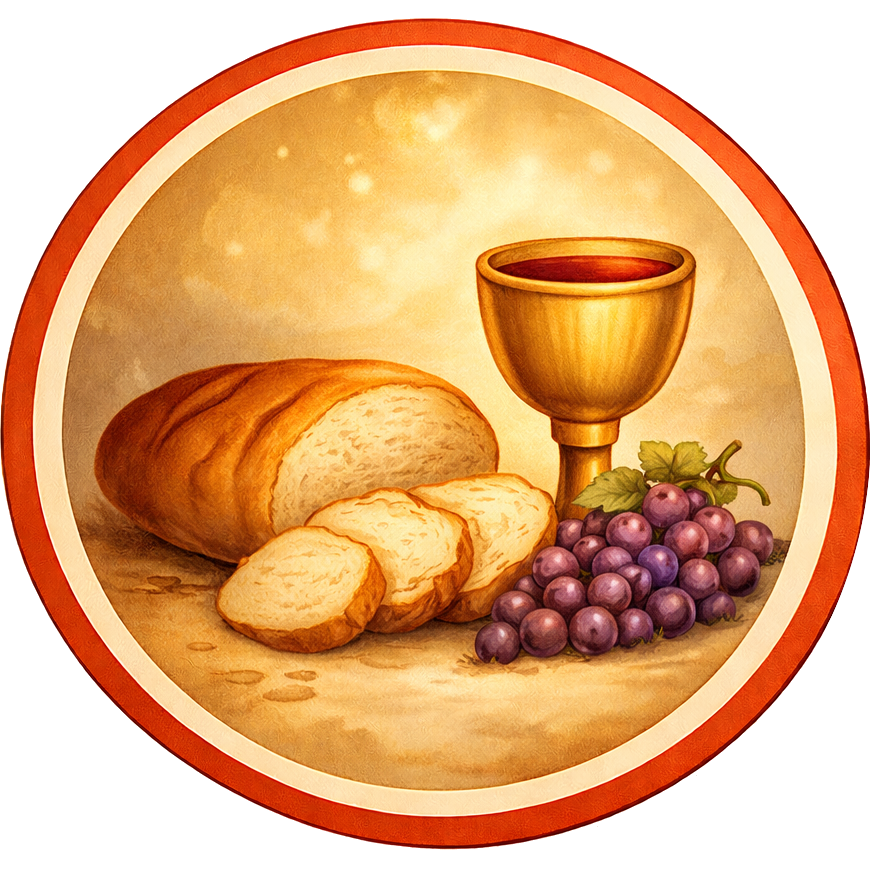
Break Bread, Drink Wine
Breaking bread and drinking wine did not begin with Jesus, nor was it a new ordinance introduced in His day. From the time of Adam, shared meals have been part of covenant worship. When Adam offered sacrifice and ate the sacred meal with his household, he was teaching his family that fellowship with God involves both giving and receiving—offering what is His, and partaking of what He permits.
What Jesus did was not to create a new ordinance, but to reveal clearly that He Himself was the fulfillment of what this ordinance had always represented.
The Meaning
The Bread
To break bread is to remember the Messiah's body, given in obedience and offered in righteousness. Bread, which sustains daily life, represents the life that comes from God and is received through submission to His will. By eating the bread, those who partake covenant to follow the laws and commandments of the Messiah.
The Wine
To drink the wine is to remember the Messiah's blood, poured out as an offering for the redemption of mankind. Blood represents life, and in drinking the wine, the worshiper acknowledges that life has been given so that life may be restored. This act teaches that forgiveness, cleansing, and reconciliation with God come through sacrifice.
This ordinance is not a mere ritual, nor is it an empty symbol. It is a covenant act performed in remembrance and anticipation.
In the Family
In God's order, this ordinance belongs in the family. The father presides over the covenant meal, just as the patriarchs did. He gathers his household—his wife, his children, and all who are part of the extended family or who have been welcomed into it—and leads them in remembrance of the Messiah.
This is not a performance for strangers or a ceremony conducted by distant officials. It is worship shared among those who are bound together by blood, by covenant, and by their common desire to know God. When families break bread and drink wine together, they renew not only their individual covenants with God but their unity with one another.
Over time, this sacred practice has been removed from the family and placed in the hands of institutions. What was once a covenant meal shared in homes, presided over by fathers, and passed from generation to generation has become a ritual administered by clergy to congregations of strangers. The intimacy has been lost. The teaching has faded. Returning this practice to its rightful place—within the family, led by the father, understood by all who participate—restores what has been lost.
Fasting
Fasting has been practiced by God's children since the days of Adam. When the patriarchs sought God for guidance, correction, or deeper communion, they set aside food and turned their full attention toward heaven. This was not a practice invented by later religions or required only under the law of Moses. It was part of the original worship.
Fasting is a form of sacrifice in which a person willingly goes without something necessary or desirable as an offering to the Lord. Most often, fasting means going without food, or without both food and water, for a set period of time. Yet simply not eating or drinking is not, by itself, a fast. Without purpose, it is only self-denial or hunger.
A true fast is defined by intent. Its highest purpose is worship of the Most High God.
The Purpose
During a fast, the body is deliberately placed in a state of need so that the spirit may be given greater attention. As the body grows weaker, the will is humbled, distractions are reduced, and the heart becomes more open to God. For this reason, fasting is joined with regular prayer.
The purpose of fasting is not to compel God to act, nor to bend Him to human will. Fasting is a change made within the worshiper. Through fasting, a person learns restraint, humility, patience, and trust. These are the qualities that make communion with God possible.
Forms of Fasting
Fasting is not limited to food and water. A fast may also be offered by giving up something that fills daily life but is not necessary for eternal life—comforts, entertainments, routines, or pleasures that normally claim time, attention, or emotional energy. When such things are willingly set aside and the time they once occupied is turned toward prayer and reflection, the offering becomes a fast.
Family Fasting
Fasting belongs not only to the individual but also to the family. A father may call his household to fast together when seeking God's direction on a matter of importance, when facing difficulty or danger, or when preparing for sacred observance.
When a family fasts together, the sacrifice is shared and the seeking is unified. Parents and children alike learn that approaching God sometimes requires setting aside even good things for the sake of something greater. Young children may fast in smaller ways suited to their age, learning the pattern even before they fully understand its meaning.
Extended families may also gather in fasting when facing significant decisions, seeking healing, or preparing for the feasts. When grandparents, parents, children, cousins, and all who belong to the family set aside food and seek God together, they present themselves before Him as one. This is how families become of one heart and one mind.

Offer Sacrifice
After the Fall, God taught Adam to offer sacrifice. This was not a human invention or a practice that developed over time. It was given by God as the means by which Adam and his family would approach Him, acknowledge their dependence on Him, and look forward to the redemption He had promised.
The firstborn male lamb without blemish, offered upon a holy altar, pointed forward to the Messiah, the Lamb of God, who would offer Himself for the redemption of mankind. Adam taught this to his children, and the faithful among them continued the practice through the generations of the patriarchs.
Understanding Sacrifice
A sacrifice was not an act of destroying an animal for God, but an ordered covenant rite carried out in His presence. The animal was first brought alive before God and presented at the altar, acknowledging that life itself comes from Him. The blood and the fat—the richest and most vital portions—were given entirely to God and burned upon the altar. These portions were never eaten, for they belonged to God alone.
The remaining flesh was not wasted; it was cooked and eaten by the one offering the sacrifice, often together with his household, as a sacred meal. Eating the sacrifice expressed peace, gratitude, and fellowship with God.
Sacrifice taught that life belongs to God, that approaching Him requires the giving of what is valuable, and that fellowship with Him is both costly and joyful.
The Father as Priest
The father served as priest of his household in these offerings. He was the one who brought the animal before God, who slew it, who handled the blood, and who led his family in the sacred meal that followed. This was not a public ceremony conducted by strangers but an act of family worship. Sons stood beside their fathers and learned what would one day be their responsibility. Daughters witnessed the cost of approaching God and the solemnity of covenant.
In Our Day
Most people today live far removed from the agrarian life of the ancient patriarchs. What was once a normal part of family life—knowing the cost of an animal's life, handling blood, and preparing food with one's own hands—has become foreign to us.
Above all, sacrifice pointed beyond itself. Every offering taught that life is redeemed through life, and that God Himself would one day provide the ultimate sacrifice. The Messiah would offer His own life freely so that God's children might be redeemed. Because of this greater sacrifice, the meaning of ancient offerings is not lost even when the outward form cannot be fully practiced.
For this reason, even when the sacrifice cannot be performed in the prescribed manner, families may still set apart sacred acts of remembrance and instruction. Certain meals can be treated as holy occasions rather than ordinary eating. The meal becomes an act of worship—not because it perfectly recreates the ancient ordinance, but because it preserves its meaning and teaches it to the next generation.
God is merciful and looks upon the heart. When His children approach Him with what they have, offering their best in humility and sincerity, He accepts their offering. A contrite spirit and an honest desire to obey are never rejected.